
Accélérer l’indexation dans Yandex
Service d’indexation en masse pour sites, pages et liens. Accélérez les réexplorations et faites entrer les URL dans Yandex Search plus vite — jusqu’à 100 000 liens par tâche.
SpeedyIndex combines bulk index checking with indexing acceleration.
Scale
Up to 100,000 URLs in one task
Value
Nous remboursons 100 % des jetons pour les liens non indexés
Automation
API, Telegram bot, and detailed reports
Pourquoi accélérer l’indexation Yandex en 2026
Yandex is a core search ecosystem for Russia and many CIS markets. If your traffic, leads, and revenue depend on these regions, Yandex index coverage is non-negotiable: if a URL isn’t indexed, it can’t reliably earn impressions, clicks, or behavioral signals—so it won’t compete for rankings.
Official reference on how Yandex crawling and indexing work: Yandex Webmaster — Site indexing.
Ce que l’accélération d’indexation vous apporte (bénéfices concrets) :
- • Faster time-to-SERP: new pages (categories, products, articles, landing pages) start earning impressions sooner—so you can test demand, snippets, and CTR faster.
- • Less post-release lag: after a release, migration, URL structure change, or redirect updates, faster recrawls help sync Yandex’s index with the live site sooner.
- • Link campaign control: if you buy or place links, you want donor pages and placements indexed—otherwise the impact is delayed or lost.
Enseignements stratégiques (et pourquoi l’indexation est la priorité n°1) :
- • Market share: based on common industry estimates, Yandex has historically captured roughly ~55–65% of search traffic in Russia across desktop/overall platforms (exact numbers vary by period and data source). For many niches, Yandex is the main organic channel.
- • Geography: indexing speed matters most for projects targeting Russia and CIS markets, where the Yandex ecosystem (Search, Maps, services) drives a meaningful share of users.
- • Commercial signals: in commercial niches, Yandex tends to weigh trust and store/service clarity (shipping, payments, contacts, assortment, pricing, legal info) heavily. But these signals can only be evaluated once pages are indexed.
- • Behavioral factors: CTR, time on site, depth of visit, and return-to-SERP behavior are meaningful “quality signals.” Indexing is required for these signals to accumulate on your target URLs. If you need new/updated pages indexed faster, you can speed up Yandex indexing with SpeedyIndex.
In a typical technical audit for large sites, a portion of sitemap URLs often stays out of the index because of duplicates, canonicalization, parameters, redirects, and weak internal linking. That’s why the best workflow is to first find not-indexed pages as a clean list, fix blockers, and then submit the “tail” from the report for indexing acceleration.
Comment choisir une méthode d’accélération d’indexation en 2026
Indexing means a URL is included in Yandex’s searchable database. Until a page is indexed, it won’t reliably earn impressions, won’t compete in rankings, and can’t drive organic traffic. That’s critical for new pages, content updates, migrations, and link campaigns: a backlink delivers limited value until the donor page is indexed.
Indexing acceleration safely increases Yandex recrawl speed, reduces post-release “lag,” and helps URLs show up in search sooner.
Why manual methods often don’t scale
- Ownership limits: Webmaster tools only work for verified domains (external URLs, donors, and competitors aren’t covered).
- Quotas and manual effort: for large volumes (catalogs, marketplaces, media sites), manual submissions become a bottleneck.
- Reporting lag: index status dashboards may not update instantly, but you often need “right now” visibility.
- Gray/black method risk: aggressive tactics that try to force pages into the index can create short-term spikes, but increase the risk of filters, junk URLs, and reduced domain trust.
Méthodes d’accélération d’indexation Yandex (comparaison 2026)
Here’s a practical comparison—from manual submissions in Yandex Webmaster to gray/black tactics. SpeedyIndex wins on speed, ROI, scale, automation, and predictability.
| Method | How it works | Pros | Cons / risks | Bottom line |
|---|---|---|---|---|
| SpeedyIndex (recommended) | You run a bulk index check, then submit the list of not indexed pages or backlinks for indexing acceleration. Supports high volumes and API automation. | 100% token refund for links that don’t get indexed. Up to 100,000 URLs per task, reporting, API, and major time savings. | Works best when URLs are clean (no 404s, redirect chains, or duplicates). | Best ROI |
| Yandex Webmaster (manual submission) | Submit individual URLs/sections for recrawling in the Webmaster panel and monitor status for your own domain. | Official workflow and solid diagnostics for verified sites. | Only works for your own verified domains; manual work; volume limits; not suitable for backlinks, donor sites, competitors, or large lists. | OK for small batches |
| Sitemap + internal linking |
Update sitemap.xml, strengthen internal linking, and build hubs/categories so the crawler discovers new URLs more often.
|
White-hat approach that improves site architecture and crawl efficiency over time. | Not a fast lever; results can be slow; hard to control speed for a specific URL list. | Strong foundation |
| RSS feeds / “fresh content” blocks | Update feeds and “new content” sections so the crawler sees frequent changes and recrawls sections sooner. | Works well for content sites and helps surface fresh posts. | Not universal; depends on publishing frequency and content quality; doesn’t solve bulk indexing at scale. | Niche tactic |
| Gray tactics (runs / mass “pings”) | Tries to trigger crawling by simulating activity around URLs (signals, automated requests/pings). | Sometimes creates a short-term spike for small volumes. | Unpredictable; risk of low-quality crawling; diluted quality signals; possible filters/limitations. | Not recommended |
| Black-hat tactics (doorways / junk URLs / spam networks) | Generates large volumes of low-quality URLs and spam signals to force crawling “at any cost.” | Can be fast in some cases, but usually short-lived. | High penalty risk, reduced domain trust, index bloat with junk pages, and long-term SEO damage. | High risk |
SpeedyIndex vs Yandex Webmaster : quoi choisir pour scaler
| Criteria | Yandex Webmaster | SpeedyIndex |
|---|---|---|
| Bulk URL processing | Limited / often manual | Up to 100,000 URLs per task |
| Checking “third-party” URLs (donors/competitors) | ❌ No | ✅ Yes |
| Focus on the “tail” (not indexed URL list) | Partial / no bulk filtering | ✅ Yes: returns a list of not indexed URLs |
| Automation | ❌ No full API for this workflow | ✅ REST API |
| Reporting | Limited | ✅ Detailed reports + task history |
| Risk-free start | — | ✅ 100 free tokens to test |


Comment créer une nouvelle tâche
100% of tokens for not-indexed links are refunded to your balance.
Préparez votre liste d’URL
Create a plain text file (.txt) with your URLs. Put one URL per line.
Téléversez la tâche
Upload the file via the Web app or the Telegram bot. Select “Yandex Indexing.”
Téléchargez votre rapport
On day 15, you’ll receive a report that splits URLs into “Indexed” and “Not indexed” and includes common blockers (for example: 404 errors, 301/302 redirects, noindex).
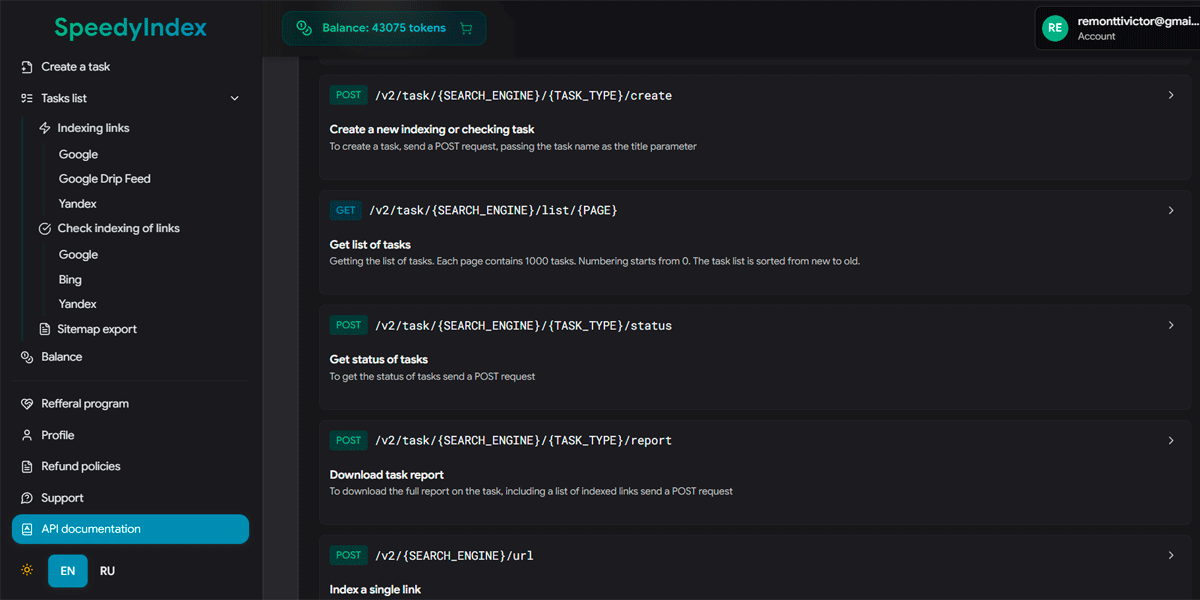
API SpeedyIndex pour accélérer l’indexation Yandex
Run Yandex indexing programmatically. Our high-performance REST API v2 is built for SEO teams and agencies that need automated indexing without delays.
1,000 links/min: High-throughput processing.
Easy integration: SDKs for Python, PHP, Node.js.
99.9% uptime: Enterprise-grade reliability.
curl -X POST "https://api.speedyindex.com/v2/task/google/checker/create" \
     -H "Authorization: YOUR_API_KEY" \
     -d '{"urls": ["https://site.com/p1", "https://site.com/p2"]}'
L’accélération d’indexation en action
Watch this 90-second video to see how to get thousands of links indexed faster with SpeedyIndex.
Codes de statut d’indexation Yandex
To succeed in Yandex Search, it helps to understand how its crawlers behave and what makes regional SEO different. Knowing these indexing statuses helps you avoid critical mistakes and traffic loss. Official term definitions are available in the Yandex documentation.
| Status / Code | What it usually means | Recommended fix | Priority |
|---|---|---|---|
| 200 OK / “Indexed” | The page is indexed with no issues. It can rank in search results. | No action needed. Monitor rankings. | Normal |
| 202 Accepted | The indexing request was accepted (for example, via API), but the crawler hasn’t processed it yet. | Wait for the crawler to revisit. | Pending |
| 301 Moved Permanently | The page moved permanently. Signals transfer to the new URL, and the old URL should drop from the index. | Make sure the redirect points to the correct destination. | Normal |
| 302 Found / 307 Temporary | Temporary redirect. The crawler may keep indexing the old URL, and signals may not fully pass. | Use only if the page is coming back. Otherwise switch to 301. | Medium |
| 403 Forbidden | Access is blocked by the server (permissions, WAF, IP blocking). | Check file permissions and your .htaccess / nginx rules. | High |
| 404 Not Found | The page doesn’t exist. If removed intentionally, it will eventually drop from search. | If the page matters, restore it or set up a 301 redirect. | High |
| 410 Gone | The page is permanently removed. Yandex typically drops 410 URLs faster than 404s. | Use this for deliberate removal of junk pages. | Normal |
| 429 Too Many Requests | The crawler is hitting rate limits. Pages can drop if crawling is consistently blocked. | Set Crawl-delay or optimize server resources. Increase limits for Yandex’s user-agent. |
Critical |
| Blocked by robots.txt / noindex | The page is accessible (200 OK) but blocked by robots directives. | Check robots.txt and <meta name="robots">. |
Medium |
| 500 Internal Server Error | Server-side error (PHP, database, scripts). | Review server logs (error.log). Developer help may be needed. | Critical |
| 503 Service Unavailable | The server is overloaded or under maintenance. The crawler will retry later. | If it happens often, your hosting resources may be insufficient. | High |
| Low-value page | The content provides limited value, duplicates other pages, or looks spammy. | Add unique content, merge pages, or block from indexing. | Medium |
| Non-canonical version | Yandex found a duplicate and consolidated it with another URL it considers primary. | Review rel="canonical". Make content unique if consolidation is wrong. |
Medium |
| Crawled but not indexed | The crawler knows about the page, but quality systems didn’t include it in the index (yet). | Improve content quality and internal linking. | Medium |
| Not crawled yet | The URL is queued for crawling, but the bot hasn’t reached it yet. | Request recrawling via “Page recrawl” or improve the site’s authority signals. | Pending |
Cas d’usage de l’accélération d’indexation Yandex
SpeedyIndex helps you not only see what’s indexed, but also run a controlled workflow: find not-indexed URLs → remove blockers → submit for acceleration → verify. Below are common situations where speeding up Yandex indexing delivers the biggest impact for websites and backlinks.
Launching new pages (fast start)
When you publish new articles, landing pages, categories, or product pages, you want them indexed quickly so they can start earning impressions, clicks, and early behavioral signals. Acceleration is especially useful for content calendars, seasonal demand, and fast SEO experiments (new clusters, regions, or offers).
Content updates and post-change recrawls
After updating copy, titles/descriptions, structure, breadcrumbs, schema, prices, or availability, you need Yandex to recrawl pages and pick up changes. Indexing acceleration helps you shorten the lag between shipping changes and seeing them reflected in search.
Backlink validation and faster donor-page indexing
In link building, donor pages and placements need to be indexed in Yandex—otherwise impact is delayed or doesn’t show up. SpeedyIndex helps you bulk-detect donors that don’t get indexed, monitor guest posts and PR placements, and accelerate indexing for the “tail” of URLs that remain out of search.
Ecommerce & marketplaces: categories, products, filters
Ecommerce sites often have index coverage gaps due to duplicates, URL parameters, faceted navigation, and pagination. Indexing acceleration helps you push priority pages (categories, top products, brand pages) into search faster, while SpeedyIndex reports show where index coverage is leaking (canonicals, robots, internal linking).
Migrations, redesigns, and post-release monitoring
During domain changes, HTTP→HTTPS, WWW vs non-WWW changes, URL structure updates, and 301 redirect rollouts, you want new URLs indexed quickly and old URLs to drop correctly. Acceleration reduces visibility drops, while ongoing checks help catch 404s, redirect chains, and canonical issues.
Recovering from index drops
If pages disappear from search after updates, template changes, robots/noindex mistakes, or server issues, you need to quickly measure the impact and bring priority URLs back. SpeedyIndex helps you compile the “not indexed” list and speed up recrawls after you fix root causes (5xx errors, redirects, duplicates, blocking directives).
Fast-changing sites: news, jobs, listings
In niches where content becomes outdated quickly (news, promotions, events, job posts, classified listings), indexing speed affects ROI directly. Acceleration helps you get fresh URLs into search sooner and keep already-indexed pages up to date in SERPs.
Expired domains, PBN screening, and quality checks
Before buying an expired domain or rebuilding a site, you want a quick read on remaining index presence. SpeedyIndex speeds up URL-pool screening: you can see what’s actually indexed in Yandex and make faster decisions on structure, content, and internal linking.
Tarifs simples et transparents
No subscriptions, no hidden fees. Every package is a one-time purchase, and your credits never expire. We offer flexible payment options, including PayPal, debit cards, and major cryptocurrencies.
- 50 LIENS INDEXÉS DANS GOOGLE
- 1 666 VÉRIFICATIONS D'INDEX GOOGLE
- 2 500 VÉRIFICATIONS D'INDEX (Google/Bing/Yandex)
- 2 500 VÉRIFICATIONS DE BACKLINKS
- 250 LIENS INDEXÉS DANS YANDEX
- 300 LIENS INDEXÉS DANS GOOGLE
- 10 000 VÉRIFICATIONS D'INDEX GOOGLE
- 15 000 VÉRIFICATIONS D'INDEX (Bing/Yandex)
- 15 000 VÉRIFICATIONS DE BACKLINKS
- 1 500 LIENS INDEXÉS DANS YANDEX
- 1 200 LIENS INDEXÉS DANS GOOGLE
- 40 000 VÉRIFICATIONS D'INDEX GOOGLE
- 60 000 VÉRIFICATIONS D'INDEX (Bing/Yandex)
- 60 000 VÉRIFICATIONS DE BACKLINKS
- 6 000 LIENS INDEXÉS DANS YANDEX
- 2 500 LIENS INDEXÉS DANS GOOGLE
- 83 333 VÉRIFICATIONS D'INDEX GOOGLE
- 125 333 VÉRIFICATIONS D'INDEX (Bing/Yandex)
- 125 000 VÉRIFICATIONS DE BACKLINKS
- 12 500 LIENS INDEXÉS DANS YANDEX
- 7 000 LIENS INDEXÉS DANS GOOGLE
- 233 333 VÉRIFICATIONS D'INDEX GOOGLE
- 350 000 VÉRIFICATIONS D'INDEX (Bing/Yandex)
- 350 000 VÉRIFICATIONS DE BACKLINKS
- 35 000 LIENS INDEXÉS DANS YANDEX
- 15 000 LIENS INDEXÉS DANS GOOGLE
- 500 000 VÉRIFICATIONS D'INDEX GOOGLE
- 750 000 VÉRIFICATIONS D'INDEX (Bing/Yandex)
- 750 000 VÉRIFICATIONS DE BACKLINKS
- 75 000 LIENS INDEXÉS DANS YANDEX
Questions fréquentes
Answers about speeding up indexing in Yandex: recrawls, getting URLs into Yandex Search, Yandex Webmaster, robots.txt/noindex, canonicals/redirects, SQI, backlink indexing, free tokens, and SpeedyIndex refunds.
Yandex indexing acceleration: the basics
Que signifie « accélérer l’indexation dans Yandex » ?
It means reducing the time between publishing/updating a URL and the moment Yandex adds that page to its searchable index (so it can start showing up in results). In practice, it’s about faster recrawling and getting updates picked up sooner, so new content, products, categories, or landing pages can start earning impressions faster.
Pourquoi l’indexation Yandex peut-elle être plus lente que Google ?
Speed depends on domain trust and quality signals (including SQI), server stability, site architecture and internal linking, duplicate/parameterized URLs, and how often Yandex decides to crawl specific sections. So it’s normal for a URL to be indexed in Google but still missing from Yandex.
SpeedyIndex garantit-il qu’une URL sera indexée ?
No. No legitimate tool can “guarantee” indexing if a URL is blocked (robots/noindex), returns 4xx/5xx errors, is a duplicate, has an incorrect canonical, sits behind redirect chains, or doesn’t meet quality thresholds. SpeedyIndex helps you run a controlled workflow: find URLs not indexed → fix blockers → submit for indexing → re-check.
When indexing acceleration matters most
Quand l’accélération d’indexation a-t-elle le plus d’impact ?
Whenever speed matters: launching new pages (articles, categories, products, landing pages), seasonal promos, frequent content updates, news publishing, price/availability changes, major releases, migrations, and redesigns. It’s also useful in link building when you want donor pages with placements indexed in Yandex sooner.
Pourquoi accélérer l’indexation des backlinks dans Yandex ?
A backlink delivers the most value when the donor page is actually indexed in Yandex. If a placement isn’t indexed, the impact can be delayed or not show up at all. SpeedyIndex helps you bulk-detect donor pages that are missing from the index and focus acceleration on them instead of wasting budget on already-indexed URLs.
Faut-il aussi accélérer l’indexation des sites anciens et de confiance ?
Often yes, but in a targeted way. Even strong domains can have slow-to-index deep catalog pages, new filters/tags, parameter URLs, and new posts in sections that get crawled less often. The practical approach is to accelerate a priority URL list from your report (categories, top products, key landing pages, important content).
Why URLs don’t get indexed in Yandex (common blockers)
Pourquoi une page peut-elle rester non indexée malgré une demande de réexploration ?
Common reasons: indexing blocks (robots.txt, meta robots noindex, X‑Robots‑Tag), incorrect canonicals, redirects and redirect chains, 404/410/5xx errors, slow servers/timeouts, duplicates caused by parameters/pagination/filters, weak internal linking, and quality constraints. Acceleration works best when you remove blockers first, then submit URLs. See the full list of issues in this table.
robots.txt ou noindex peuvent-ils cacher une page à Yandex même si elle s’ouvre dans le navigateur ?
Yes. A URL can be accessible to users but blocked for crawlers. Check robots.txt, meta robots tags, and the X‑Robots‑Tag header.
After removing the block, you’ll need a recrawl—then it’s a good idea to re-check index status with SpeedyIndex.
Pourquoi les doublons (paramètres, filtres, pagination) nuisent-ils à l’indexation ?
Duplicates inflate the number of URLs, waste crawl resources, and make it harder for the search engine to choose the “main” version. In Yandex, this is especially common in ecommerce: filters, sorting, UTM tags, and URL variants can create dozens of near-duplicate pages. Fixes include canonicals, 301 redirects to the main version, blocking junk parameters, and strengthening internal linking to priority pages.
How to use SpeedyIndex: the workflow
Quel est le meilleur flux : vérifier → accélérer → confirmer ?
1) Upload a URL list (up to 100,000). 2) Get a report and the list of not indexed URLs. 3) Filter out technical junk (404s/redirects/duplicates/noindex). 4) Submit only clean, high-priority URLs for indexing acceleration. 5) Re-check in 24–72 hours (then on a schedule) and track progress.
Quelles URL soumettre en premier ?
A typical priority order: (1) pages that drive revenue/leads (categories, top products, commercial landing pages), (2) key informational hubs/articles, (3) pages that support internal linking (categories/subcategories), (4) pages with external placements (donors/PR). Avoid accelerating technical duplicates and parameter URLs—fix those first.
Peut-on automatiser l’accélération d’indexation Yandex via une API ?
Yes. SpeedyIndex supports an API, so you can plug the workflow into your processes: pull URLs from sitemaps/CRM/inventory, submit lists, fetch reports, segment by page type (categories/products/articles/donors), and run scheduled re-checks. This is especially useful for agencies and large sites.
Reports and interpreting results
Que montre SpeedyIndex : « indexée » ou « explorée » ?
SpeedyIndex focuses on whether a URL is actually present in Yandex’s searchable index (“indexed/in search”). A crawler may fetch a page but still keep it out of the index due to duplicates, quality issues, canonicalization, or technical problems—so “crawled” ≠ “indexed.”
Pourquoi le statut peut-il changer d’un contrôle à l’autre ?
Yandex’s index and SERPs are dynamic: updates, quality recalculations, main URL selection, regional factors, and technical fluctuations can change what appears in search. The best practice is ongoing monitoring: repeated checks of the same URL list and report comparisons.
Combien de temps attendre après la soumission des URL ?
It depends on URL quality, server availability, and crawl frequency. Often you’ll see movement within a few days, but large catalogs and new domains can take longer. A practical schedule is to re-check in 24–72 hours, then keep monitoring (for example, 1–2 times per week) until things stabilize.
Free tokens & refunds
Comment obtenir 100 jetons gratuits pour tester le service ?
Every user who signs up with a Gmail address gets 100 free tokens to test SpeedyIndex. It’s a simple way to try the workflow on your own URL list and evaluate reports with no risk.
Que signifie « remboursement 100 % des liens non indexés » ?
If you submit links for indexing acceleration and some of them do not get indexed, you receive a token refund back to your balance equal to the indexing cost of those URLs. Example: you submitted 100 links and they did not get indexed—then the cost to index those 100 links is refunded in tokens.
Safety and best practices
L’accélération d’indexation est-elle sûre ? Peut-elle entraîner des pénalités ?
Safety depends on what you’re submitting. If you accelerate high-quality pages (200 OK, no duplicates, no hidden blocks, useful content), it’s a normal SEO practice. Risks are usually tied to gray tactics and accelerating junk URLs (thin pages, doorway pages, parameters, duplicates). The best approach is: filter first, fix blockers, then submit.
L’accélération d’indexation remplace-t-elle le SEO technique ?
No. Acceleration helps search engines pick up changes faster, but it doesn’t fix root causes. If you have robots/noindex, canonical, redirect, duplicate, performance, or content-quality issues—fix those first. Then acceleration will be more effective and stable.